Keeping Watch Over the Upper Delaware: New Reports Signal Progress for the Tailwaters
If you’ve spent any time along the Upper Delaware River (UDR) tailwaters in recent years, you’ve probably noticed something encouraging: more attention is finally being paid to this remarkable fishery and watershed system.
That increased focus from the New York State Department of Environmental Conservation (NYSDEC) and the Pennsylvania Fish and Boat Commission didn’t happen by accident. It’s the direct result of years of advocacy and persistence from Friends of the Upper Delaware River (FUDR), Trout Unlimited, and the many conservation-minded anglers and supporters who continue to speak up for these waters.
Today, both agencies are more actively engaged in everything from fisheries policy to habitat protection and restoration. Much of that work is grounded in two important frameworks: the 2022 NY/PA Joint Fisheries Investigation Plan (JFIP) and the 2025 UDR Joint Tailwaters Trout Management Plan, commonly referred to as the “UDR Trout Plan.”
Recently, two significant reports connected to those efforts were released, both offering valuable insight into the health and future management of the watershed and the wild trout fishery.
A Closer Look at the Catch-and-Release Impact Study
Back in 2022, New York State opened all trout waters to year-round angling, a decision that sparked considerable debate among anglers across the state. Many UDR anglers worried about the possible effects expanded fishing pressure could have on tailwater trout during sensitive spawning periods.
In response to those concerns, NYSDEC committed to a three-year impact study examining 19 high-quality trout rivers, including the UDR tailwaters.
The study focused heavily on monitoring “Young of the Year” (YOY) trout populations while also conducting visual inspections of angling activity in heavily used spawning areas. The goal was straightforward: determine whether the October-to-April catch-and-release season was negatively affecting trout recruitment or river health.
For the Upper Delaware tailwaters, the findings were reassuring. The study concluded that the expanded angling season resulted in minimal to no measurable impacts on YOY trout populations.
That said, the conversation doesn’t end there.
FUDR and Trout Unlimited carefully reviewed the study results and provided constructive feedback to the agencies, including suggestions to:
Make future reports more accessible and readable for stakeholders
Better account for differences in scale between the rivers studied
Create opportunities for more angler participation and input
Expand documentation explaining study methods and monitoring practices
As with any long-term fisheries management effort, transparency and continued collaboration remain critical.
The First Annual UDR Report Card
Another milestone stemming from the UDR Trout Plan is the release of the very first Annual UDR Tailwaters Fishery Report Card.
This report represents an important commitment from NYSDEC to provide anglers and watershed stakeholders with regular updates on the condition of the wild trout fishery and the progress being made toward management goals.
Think of it as a yearly “health check” for the river system.
The Report Card is designed not only to track current conditions but also to guide future management decisions. If scoring metrics begin to show declines or emerging problems within the fishery, the agencies can adapt their management strategies accordingly.
For those of us who care deeply about the future of the Upper Delaware, this type of accountability and ongoing evaluation is a welcome step forward.
Why These Reports Matter
The Upper Delaware tailwaters are more than just a destination fishery. They are a living, complex watershed that supports wild trout, local communities, recreation, and a long tradition of stewardship.
That’s why angler observations and public involvement remain so important.
Anglers and other river users who spend significant time on the river, watch seasonal changes unfold, and notice subtle shifts in insect hatches, temperatures, flows, and fish behavior often provide insights that no data sheet alone can capture.
We strongly encourage everyone with an interest in the UDR watershed and its wild trout fishery to review these reports and stay engaged.
Another important element of the Tailwaters Plan is the use of a QR Code angler survey to gather important information about the UDR angling experience that can be used by the DEC to further refine their fisheries management efforts. DEC has placed survey signs at multiple access points along the river for your convenience and it only takes a few minutes to complete the survey. Thank you for taking the time to fill out the survey!
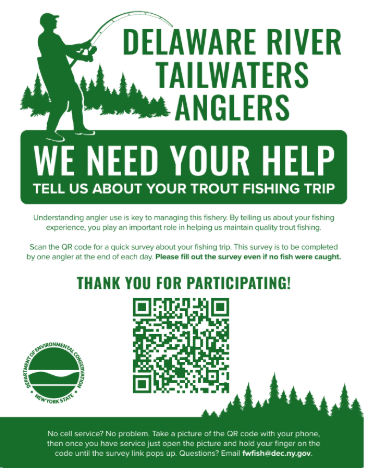
Delaware River Tailwater Anglers Survey QR Codes have been placed by NYSDEC throughout the river at various public accesses
As always, if you have questions, observations, or suggestions, please continue sharing them. Strong communication between anglers, conservation groups, and fisheries agencies is one of the best tools we have for protecting this incredible river system for generations to come.